 |
| Charles and Harmony Ives in West Redding, 1946 (photo: historyofredding.com) |
Charles Ives has been referred to
by many in the classical music world as America’s first true national composer
(though the validity of this is certainly debatable if not completely untrue).
Ives fits the bill for any number of reasons. Fully American in birth, Charles
Edward Ives was born in Danbury, Connecticut, on October 20, 1874 to George
Ives, a U.S. Army bandleader in the Civil War, and Mary Parmelee, a homemaker.
He was American in his influence- much of his father’s career as a bandleader
can be heard in the tunes references throughout Ives’ body of composition. He
was also American in the fact that he was truly living a variation of the
American dream; he was an insurance salesman by day to pay the bills, and a
composer and musician in his remaining time. Any number of Google searches will
return results stating Ives’ great influence on the American tradition of
classical composition. “…unifying the voice of the American people…”, “one of
the first great American composers of international renown,” “the first true
great American composer…undoubtedly, and “ significant American composer” are
all blurbs appearing within the stubs of links only on the first page of
results. Such an influential character seems to be one whose legacy would also
be well preserved. Unfortunately, however, this is not the case.
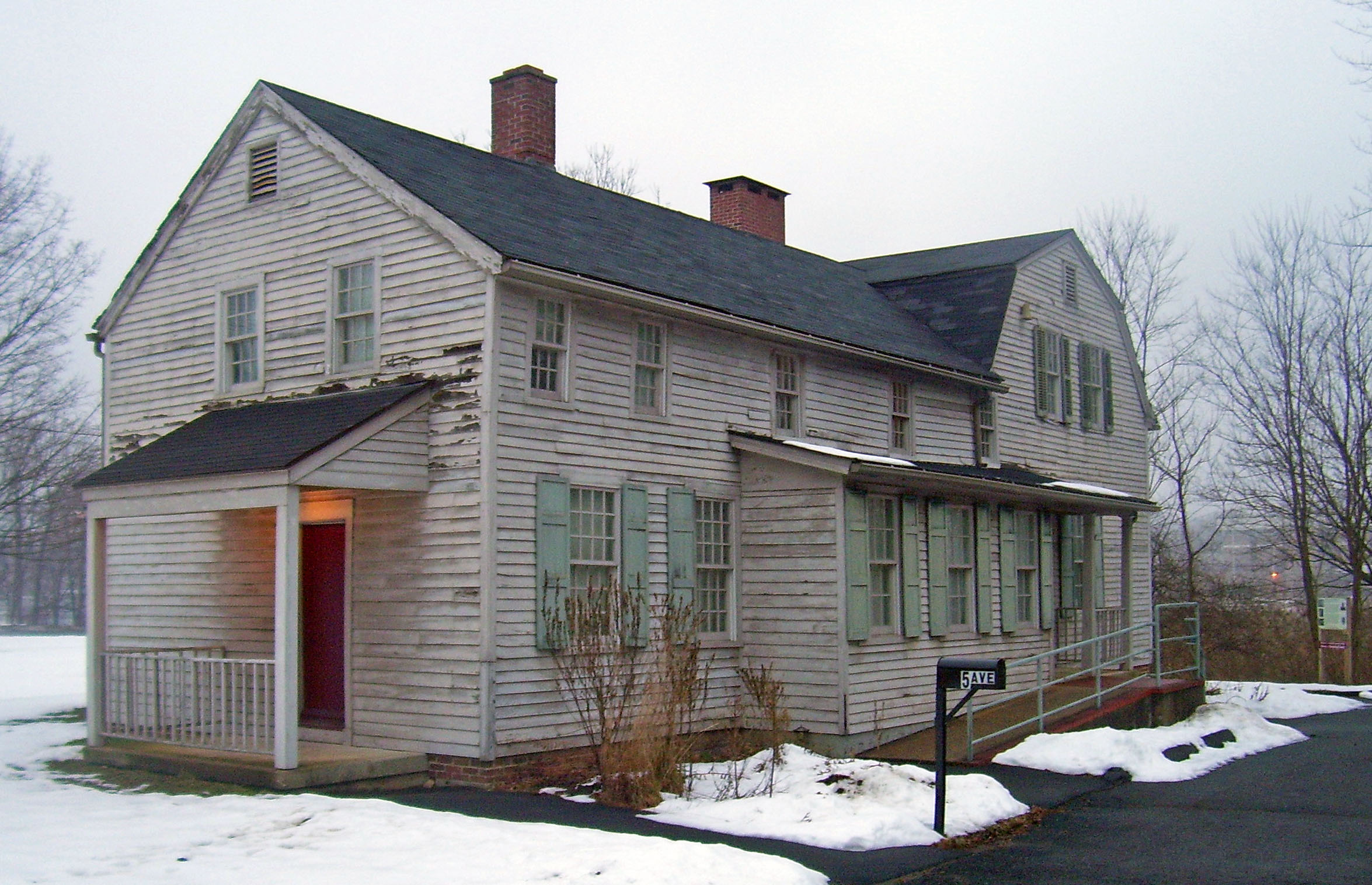 |
| The Ives House in Danbury (photo: Wikipedia) |
Ives grew up in a house that was
originally located on Mountainville Avenue in Danbury, the same house where he
was born. Over the course of the 19th century, it was home to
several generations of Ives’. Thomas Tucker built the house at the end of the
Revolutionary War in 1780. It was purchased by the Ives family in 1828 by Isaac
Ives, whose son George became influential to the town’s history. George founded
the Danbury and Norwalk Railroad, which is still in use today as the Danbury
Branch of the Metro-North Railroad, as well as the Savings Bank of Danbury. The
house has been moved several times due to the expansion of Danbury’s main
square and its banks. It was added to the National Register of Historic Places
in 1976. The Historical Society of Danbury now owns the house and wishes to open
it as a museum (as of 2014). Although this home is undoubtedly Ivesian and
connected to him in many ways, Charles Ives only resided within it. He had no
hand in creating the residence or any of his body of music within it.
 |
| Ives' home in West Redding (photo: Steve Miller for the Boston Globe) |
Upon graduation from his baccalaureate
degree from Yale, Ives moved to Manhattan to pursue a career as an insurance
agent. Over time, as it does with many people, the Big Apple tired Ives greatly
and he desired an oasis away from the bustling streets. In August of 1912,
Charles and his wife Harmony came to West Redding, Connecticut (just fifteen
minutes from his hometown of Danbury) and purchased 18 acres of land on which
to build a retreat. Ives helped to design the house himself in the Arts and
Crafts style of design which was popular in the early 20th century.
Construction was completed in 1913. The property was a farm at heart, complete
with a barn which housed Ives’ beloved horse Rocket. The barn, however, did not
house many animals other than Rocket; it became home to Ives’ elaborately filed
collection of manuscripts of his compositions. Upon the completion of the
country home, Charles and Harmony Ives came to spend more and more of their
time there as years came to pass.
 |
| Ives' music room (photo: Steve Miller for the Boston Globe) |
 |
| Ives' photo of Brahms (photo: Steve Miller for the Boston Globe) |
During the periods when they were
not taking residence in the West Redding home, they actually lent it to
impoverished families in need of temporary residence. The couple were true
lovers of community and children in particular- they took such a liking to one
child who stayed at the home when she was ill that they eventually adopted her!
Many of Ives’ most well known pieces were composed in his music room at the
home including “Three Places in New England,” the “New England Holidays”
symphony, the Second Orchestral set, the Fourth Symphony, the Fourth Violin
sonata, and many of his vocal/piano songs. In his music room, Charles had many
relics from different parts of his life: his father’s bugle, a pennant stolen
from his baseball days at Yale, a portrait of Brahms hanging from the back of
his James and Holstrom upright piano, and several bottles of whisky. On the
back of the door to the room hung a collection of clippings showing the success
of Ives compositions he saw during his lifetime.
 |
| Charles Ives Tyler in his grandfather's music room (photo: Steve Miller for the Boston Globe) |
When Ives died in 1954, he did not
think to plan for the passing on of the property he and Harmony so lovingly
created in West Redding. After Harmony passed in 1969, it was simply left to
his descendants and the home stayed within the family as a summer residence…
until 2011. Charles Ives Tyler, grandson of Charles Ives, put the home on the
market in the summer of 2011. A resident of Florida, the property had become
too much to upkeep from such a distance and, at 67 years old, Tyler felt it had
become a burden. The first potential buyer was a commercial company who wished
to tear down the residence and build a condo complex on the acreage. Of course
word got out to the many Ives fans, American and otherwise, and an
international outrage came about. In an editorial by Jan Swafford on the
controversy he states that the house is “not only historic but a true creation
of the artist who designed and built it.”
The small but passionate Charles
Ives Society wished to purchase the property and turn it into an artists’
retreat a la the Aaron Copland house. Robert Eschbach (a former professor of
mine at the University of New Hampshire) started an online petition to keep the
house within the foundation which gathered over 2000 signatures as well as
gaining financial support for the Charles Ives Society’s plea to purchase. They
gained a competitive sum and made an offer, which was subsequently refused by
Tyler. In the end the home sold for $1.5 million to John Moon, a finance
executive at Morgan Stanley. The reason for his decision still remains fairly
ambiguous. In discussion with Tyler, Boston Globe correspondent Jeremy Eichler
could not uncover the motivation:
“What has baffled so many
onlookers, however, is why Tyler, after responsibly tending to his
grandfather’s legacy for decades, has rejected a seemingly competitive offer to
sell the West Redding home to the Charles Ives Society, which, working with
local partners, could have turned it into a public museum or a center for
visiting artists in residence. I posed the question in as many different ways
as I could think of, but he declined to elaborate.”
 |
| Ives' study resurrected in Washington Heights (photo: Martin Solarte for the NY Times) |
Ives’ belongings, however, were not
neglected. In early 2014, the contents of Ives’ music room were moved to the
American Academy of Arts and Letters in Washington Heights, NYC. All three
thousand items were assembled in an exact replica of the study, complete with a
photo taken from the window so you really feel like you are in the true space. His
manuscripts in the barn were previously donated to Yale’s collection, one thing
that Ives had indeed stated in his will.
 |
| Some of Ives' collection of belongings (photo: stamfordadvocate.com) |
The entire situation of the sale
and loss of Ives’ home to what, in the end, amounts to big business over the
arts is a painful reminder of the priorities of many minds within our nation. A
place which should truly be considered a national treasure sold for a paltry
sum. LeBron James, NBA all-star, is currently in the news because he had to
lower the price of his Miami home from $17 million to $15. Although many people
are undoubtedly influenced and inspired by this athlete, he comparatively has
done nothing for the history of the nation compared to an artist such as Ives.
This, however, is the status quo and the priorities which lie within. Western
classical music is a world largely considered to be pale and irrelevant to the
goings on of our time. As musicians, we know this to absolutely be untrue, but
the general public agrees to disagree. I fear that many members of the population
would feel that since Ives’ manuscripts were preserved- the true articles of
his creation- there is no need for his residence to be kept the same way. The
situation as a whole shows the true need for us as artists to continue to fight
for the legacy and relevancy of our craft to modern times. We must remain
adamant that these elements of history are indispensable and refuse to align
ourselves with the misguided notion that they are trivial.
Susannah Thornton
Susannah Thornton
